How to resolve AdBlock issue?
Refresh this page
Lake County News,California
  • Home
    • Registration Form
  • News
    • Education
    • Veterans
    • Community
      • Obituaries
      • Letters
      • Commentary
    • Police Logs
    • Business
    • Recreation
    • Health
    • Religion
    • Legals
    • Arts & Life
    • Regional
  • Calendar
  • Contact us
    • FAQs
    • Phones, E-Mail
    • Subscribe
  • Advertise Here
  • Login
How to resolve AdBlock issue?
Refresh this page

News

Lake County raises concerns over proposed Medi-Cal Mobile Crisis changes

LAKE COUNTY, Calif. — Lake County Behavioral Health Services on Tuesday said it is sharing information and raising concern regarding a proposed state budget change that could shift the non-federal share of Mobile Crisis costs from the state to counties. 

Mobile Crisis is currently delivered as a statewide Medi-Cal benefit and provides field-based behavioral health crisis response, stabilization and connection to care.

Mobile Crisis supports public safety and access by responding to behavioral health crises in the community, reducing unnecessary law enforcement involvement, and diverting avoidable emergency department utilization when clinically appropriate. 

In rural counties like Lake, Mobile Crisis is a core component of the emergency response system and helps ensure people in crisis can access timely, clinically appropriate support.

“Mobile Crisis is one of the most effective tools we have to respond to behavioral health crises quickly and safely in the community,” said Elise Jones, director of Lake County Behavioral Health Services. “If the financing structure changes in a way that shifts costs to counties, rural communities could face difficult decisions that reduce response capacity and shift the burden back to law enforcement, emergency departments, and the jail. We encourage preserving Mobile Crisis as a statewide benefit to protect access and public safety.”

“Mobile Crisis gets the right response to the right place at the right time specialized behavioral health professionals, not law enforcement, when it’s clinically appropriate,” said Lake County Sheriff-Coroner Luke Bingham. “It helps stabilize crises safely in the field and reduces pressure on 911 and emergency departments. If funding shifts to counties and Mobile Crisis capacity shrinks, the calls don’t disappear they shift back to 911, law enforcement, and emergency rooms, increasing strain across the public safety system.”

Lake County’s Mobile Crisis program has demonstrated significant community reach. Between June 30, 2024 and June 29, 2025, Mobile Crisis teams responded to 990 field incidents, with an average activation-to-arrival time of 21 minutes and 52 seconds.

For additional information, residents may contact their state legislative offices:
• Sen. Mike McGuire (Senate District 2);
• Assemblymember Cecilia M. Aguiar-Curry (Assembly District 4).

Full-length warning siren test on Feb. 2

LAKE COUNTY, Calif. – The Lake County Sheriff’s Office will conduct a full three-minute test of the warning sirens in Middletown, Anderson Springs, Cobb, Loch Lomond, Kelseyville Riviera (formerly known as the Clear Lake Riviera) and Riviera West. 

The test will take place at 11 a.m. Monday, Feb. 2.

The test is part of ongoing preparedness efforts for emergencies such as wildfires, earthquakes or other hazards.

Monthly siren tests occur on the first Monday of each month at 11 a.m.

Tests from March through January will last 30 seconds, while the February test is the full three-minute activation.

Notifications about these tests will be sent via LakeCoAlerts and Nixle just before each test.

What to do when you hear sirens outside of scheduled tests

If you hear sirens outside of a scheduled test, it’s important to stay alert and seek more information. 

The sirens may not always be heard depending on factors like terrain, background noise, being indoors, or your distance from the sirens. 

Always remain vigilant and follow any instructions provided.

Who to contact with questions

The Middletown, Anderson Springs, Cobb, and Loch Lomond sirens have been in place since 2018 and are maintained by the South Lake County Fire District. Should there be any issues, please contact South Lake County Fire District at 707-987-3089.

In 2021, the Kelseyville Riviera Homeowners Association installed three warning sirens. Should there be any issues, please contact the Kelseyville Riviera Homeowners Association at This email address is being protected from spambots. You need JavaScript enabled to view it.. 

The Riviera West warning sirens were installed in 2023. Should there be any issues, please contact the Riviera West Homeowner Association’s President at This email address is being protected from spambots. You need JavaScript enabled to view it.. 
 
Prepare: Visit Ready.LakeCountyCA.gov

The Lake County Sheriff’s Office urges all residents take steps to prepare for all hazards which includes opting in for LakeCoAlerts and learning your zone. For details visit https://Ready.LakeCountyCA.gov. 

Stay informed by following the Office of Emergency Services and the Lake County Sheriff on Facebook at http://www.facebook.com/lakecountyOES and www.facebook.com/lakesheriff. 

Clearlake and county emergency services jointly lead sewage spill recovery, confirm 200-plus properties impacted

LAKE COUNTY, Calif. — The city of Clearlake on Monday said it has assumed joint command of the recovery effort for the nearly three-million-gallon Robin Lane sewage spill — together with the Lake County Office of Emergency Services — revealing a new estimate for the number of properties impacted.

For the first time, officials confirmed that the number of impacted properties relying on private wells for drinking water has risen to more than 200, according to the Monday announcement by the city of Clearlake.

This represents a significant increase from the 58 properties cited in the city's initial emergency declaration on Jan. 12, issued while the spill was still active.

Over the past two weeks, none of the public announcements or email correspondence from the county  — the agency responsible for the spill and response — have stated the updated number of impacted properties, despite high public interest and multiple requests from Lake County News.

The city of Clearlake announcement stated that City Manager Alan Flora and Lake County Undersheriff Corey Paulich will serve as “joint incident commanders” in accordance with protocols for multi-jurisdictional incidents. 

“Since the primary impacts of the incident are occurring within city boundaries and affect local neighborhoods, public spaces, and municipal infrastructure, the joint command structure ensures the city has an active leadership role,” the city’s announcement said. 

Under the new structure, Flora leads jurisdictional coordination and Paulich directs county resources. Lake County Special Districts remains responsible for operating and repairing the sewer system. 

This new arrangement came five days after the Jan. 21 town hall with county leadership and impacted residents, where Flora spoke publicly about his dissatisfaction. 

“I'm going to be really blunt — I'm pissed about a lot of things too,” Flora said at the town hall. “I hope you know that you can't see everything that is happening, but there's a lot of people fighting for you.”

The Monday announcement also said the transition in leadership intends to support “coordinated oversight” and “will strengthen coordination, resource alignment, and public communication.”

The response and recovery efforts follow the Jan. 11 rupture of a force main on Robin Lane owned and operated by Lake County Sanitation District, which is overseen by Lake County Special Districts.

The spill released an estimated 2.9 million gallons of raw sewage across the road into what a Robin Lane resident described as “a river of poop and pee.” 

The impact zone has expanded beyond the immediate spill area to nearly 300 acres, encompassing areas east of Smith Lane, west of Old Highway 53, south of Pond Road and north of Bowers Avenue, according to the county’s latest update on Sunday.

The Special Districts reported that the spill lasted about 37.5 hours, according to the Monday announcement. However, that does not align with the hours publicly stated by staff.

Lori Baca, a customer service supervisor for the Special Districts, said at the Jan. 14 town hall that the department was notified of the spill at 7:30 a.m. on Jan. 11 and that the flow was stopped at 9:55 p.m. on Jan. 12 — a duration of approximately 38 hours and 25 minutes.

Still, residents on Robin Lane have disputed this timeline, posting videos and photographs on social media that they said showed the leak was still active beyond the time. 

Where are the water tanks?

Affected residents have lived without clean running water for 15 days due to the county infrastructure failure. Most of them have not been provided with a water tank large enough to supply water for the household based on Public Health Officer Dr. Bob Bernstein’s recommendation of a minimum of 60 gallons of clean water per person per day.

Despite a county budget allocation to provide affected residents with water tanks, the equipment has not yet materialized

On Wednesday, Jan. 21, the Board of Supervisors called a special meeting and approved $750,000 for the Special Districts to purchase 60 water tanks — each holding 2,500 gallons — and to provide refilling services for affected households. 

“We need to provide a certain level of dignity and quality of life back to the people that are living in those areas,” District 2 Supervisor Bruno Sabatier, whose district is ground zero for the incident, said at the meeting. 

Sabatier requested emphatically to have the water tanks ordered by the end of that day. 

Special Districts Administrator Robin Borre said later that evening that an order of 20 tanks was placed. 

On Friday, the county’s update said water tank installation would begin on Monday. It did not include numbers of water tanks ordered or received by the county.

On Saturday, the county update upheld the Monday start date for installation. However, on Sunday, the update stated installations were expected to begin on Tuesday instead, without specifying the reason for the delay.

So far, the only water tanks installed by the county appear to be the 1,500-gallon units for smaller households, administered through the Department of Social Services' Home Safe program, which is separate from the newly approved $750,000 fund. 

Last Wednesday, Lake County News was told by the county that “at least one tank has been installed” while “multiple are in process” through the program.

Lake County News on Monday asked the county how many tanks have been ordered and received so far by Special Districts, why there is a delay in water tank installation, and whether the Tuesday installation start date is guaranteed. 

Questions were also submitted regarding how many 1,500-gallon tanks have been installed through the Home Safe program. 

The county had not responded to any of these questions by the time of publication.

Lake County News forwarded the email of inquiries to the city of Clearlake at 4:09 p.m., 15 minutes after the joint command was announced.

“We are just stepping into this role this afternoon so I will send over any responses to your inquiry below as soon as possible,” said City of Clearlake Administrative Services Director Melissa Swanson in an email. 

After all, even if fully deployed, 60 tanks would serve less than one-third of the affected households, while it remains uncertain how many more tanks the county has actually ordered than the initial 20. 

Well testing progress remains uncertain

With the new confirmation that over 200 properties relying on private water wells are impacted, the county’s well testing progress disclosed so far is insufficient to tell the full story.

By Friday, the county said approximately 175 water samples had been collected and analyzed. But it did not specify how many individual wells those samples were drawn from, nor how many tested positive for coliform and E. coli, which are water quality indicators of contamination by fecal bacteria.

That update also stated 60 private wells had been sanitized, with 55 tested again following treatment. Out of that 55, results are “encouraging,” the county update said, with most samples showing no detectable contamination and eight wells with contamination.

No well testing data has been released since then. It remains unclear how many wells from the more than 200 impacted properties have been tested, sanitized and retested so far, or what the wider implications of the results may be.

As of Monday, all public safety guidance including well testing, water use precautions and health recommendation from Lake County Health Services remain unchanged. 

A Nixle alert issued by the Clearlake Police Department on Monday evening said city-led assessment teams will be contacting residents at affected properties beginning at 8 a.m. Tuesday, Jan. 27.

The third in a series of town halls on the spill will take place at 6 p.m. Wednesday, Jan. 28, at Clearlake City Hall, 14050 Olympic Drive.

Lingzi Chen is a staff reporter at Lake County News and a 2024-2026 California Local News Fellow. Email her at This email address is being protected from spambots. You need JavaScript enabled to view it.. 

California’s unemployment rate improves in December; Lake County rate up slightly

LAKE COUNTY, Calif. — The year 2025 closed with an improved unemployment rate for California, while Lake County’s rate was up slightly at year’s end.

The California Employment Development Department’s newest report said California’s unemployment rate came in at 5.5 in December, a decrease from the revised rate of 5.6% posted for November. 

Lake County’s unemployment rate for December was 7.7%. In November, the rate was 7.5%. The December 2024 unemployment rate was 7.6%.

The Bureau of Labor Statistics said the national unemployment rate in December was 4.4%, down from 4.5% in November. The December 2024 national unemployment rate was 4.1%.

The Employment Development Department report said that in December, total nonfarm jobs in California’s 11 major industries amounted to 18,021,200 – a loss of 1,700 from November. This followed November’s downward revision of 2,000 jobs, resulting in a month-over November gain of 30,500 jobs.

The report said the number of Californians employed in December was 18,839,100, up 37,800 from November and up 221,100 compared to December of last year.

At the same time, the number of unemployed Californians was 1,096,100 in December, a decrease of 8,800 from November, but an increase of 20,600 from December 2024.

In Lake County, the number of employed totaled 26,310 in December, down by just 10 from the previous month. Unemployed individuals totaled 2,020 in December, compared to 1,990 in November.

December’s year-over nonfarm job loss (-11,200) marks the first year-over decrease since March 2021, the report explained.

For Lake County, total nonfarm jobs grew from 17,260 in November to 17,300 in December, a 0.2% increase over the month and a 1.9% year-over growth.

Regarding total farm jobs, the number of jobs in the agriculture industry decreased from November by 3,400 to a total of 425,100 jobs in December. The agriculture industry had 3,600 more farm jobs in December 2025 than it did in December 2024, the Employment Development Department reported.

For Lake County, the total farm job category showed the most growth from month to month but the largest year-over loss. From November to December, the category grew by 25%, 240 to 300, but was down 62.5% since December 2024.

The report said five of California's 11 industry sectors gained jobs in December. Most notable of that group included the following:

• Private education and health services (+5,000) showing gains for the 47th consecutive month as California’s population continues to age. The industry saw gains posted in hospitals and social assistance. In Lake County, it grew by 1.2% over the month.
• Government (+4,500) saw the second largest month-over increase due, in part, to gains in local government (+3,900) as well as from above average gains in state government educational services. In Lake County, this category was down 0.4% from November to December.
• Construction (-5,000) experienced the largest month-over decline driven largely by very wet weather throughout the month with above average losses in utility system construction and building finishing contractors. The mining, logging and construction category showed no change for Lake County from November to December.

Lake County’s unemployment rate for December gained it a statewide rank of 47 out of California’s 58 counties.

Its neighboring counties had the following rankings: Colusa, 14%, No. 57; Glenn, 7%, No. 42; Mendocino, 5.7%, No. 27; Napa, 4.3%, No. 8; Sonoma, 4.2%, No. 6; and Yolo, 5.8%, No. 29.

The lowest unemployment in the state in December was in San Mateo County, which had a 3.5% rate, while Imperial County had the highest with 18.6%.

In related data that figures into the state’s unemployment rate, there were 386,980 people certifying for Unemployment Insurance benefits during the December 2025 sample week. 

That compares to 363,076 people in November and 398,795 people in December 2024. Concurrently, 47,492 initial claims were processed in the December 2025 sample week, which was a month-over decrease of 6,059 claims from November and a year-over decrease of 1,523 claims from December 2024, the Employment Development Department said.

Email Elizabeth Larson at This email address is being protected from spambots. You need JavaScript enabled to view it.. Follow her on Twitter, @ERLarson, and on Bluesky, @erlarson.bsky.social. Find Lake County News on the following platforms: Facebook, @LakeCoNews; X, @LakeCoNews; Threads, @lakeconews, and on Bluesky, @lakeconews.bsky.social. 

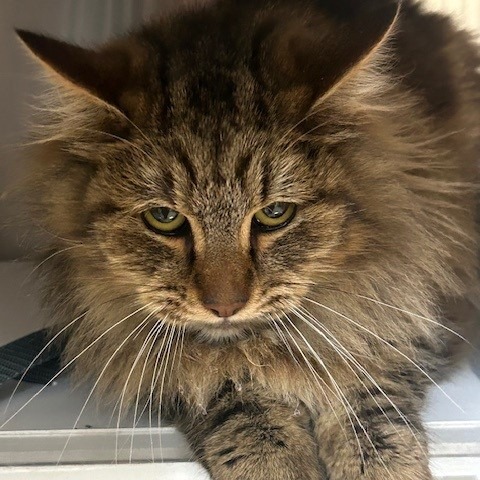
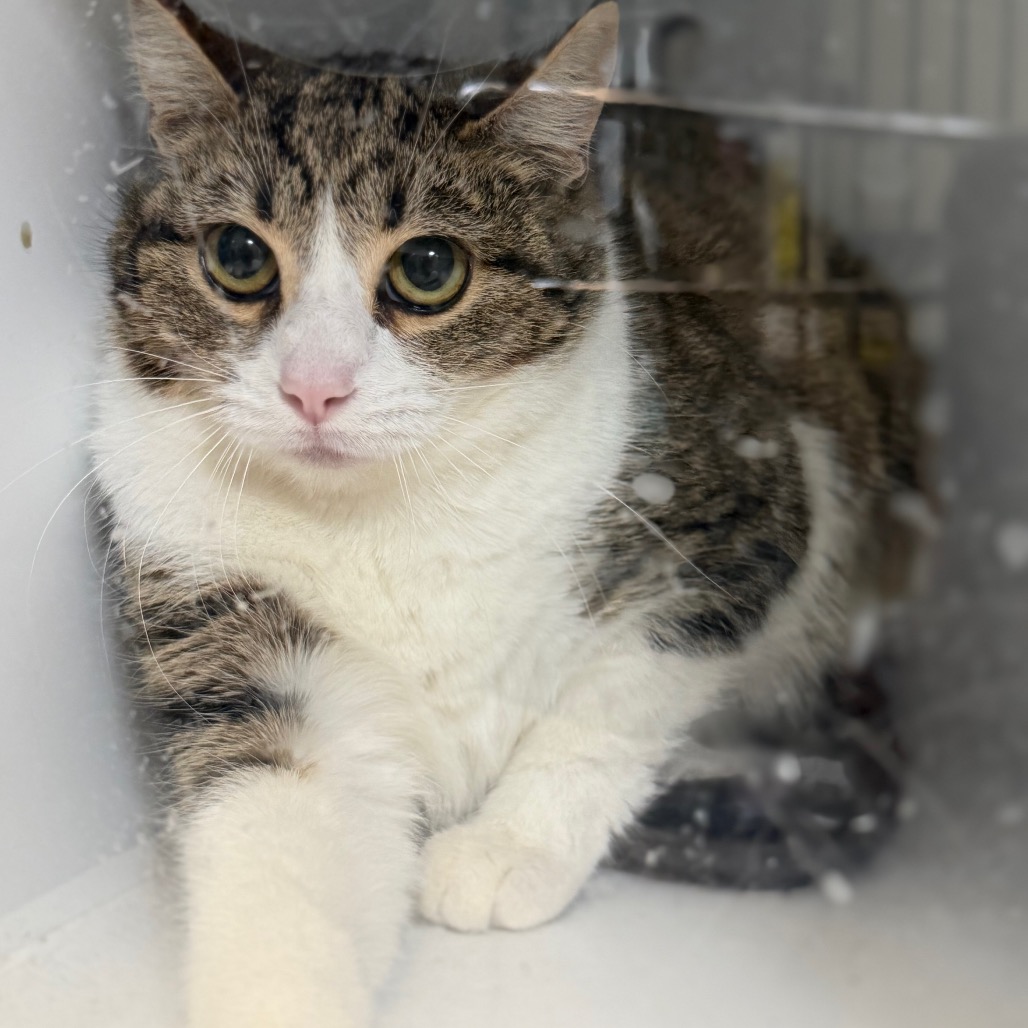
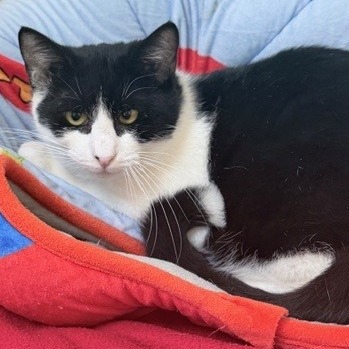
Purrfect Pals: This week’s cats

LAKE COUNTY, Calif. — Lake County Animal Care and Control has several adult cats waiting to be adopted by new families.

The kittens and cats at the shelter that are shown on this page have been cleared for adoption.

Call Lake County Animal Care and Control at 707-263-0278 or visit the shelter online for information on visiting or adopting.

The shelter is located at 4949 Helbush in Lakeport.

Email Elizabeth Larson at This email address is being protected from spambots. You need JavaScript enabled to view it.. Follow her on Twitter, @ERLarson, and on Bluesky, @erlarson.bsky.social. Find Lake County News on the following platforms: Facebook, @LakeCoNews; X, @LakeCoNews; Threads, @lakeconews, and on Bluesky, @lakeconews.bsky.social. 

C#26's preview photo
C#26

C#20's preview photo
C#20

A#68 Lucy's preview photo
A#68 Lucy

C#117's preview photo
C#117
 
C#21's preview photo
C#21


How the polar vortex and warm ocean intensified a major US winter storm

Boston and much of the U.S. faced a cold winter blast in January 2026. Craig F. Walker/The Boston Globe via Getty Images

A severe winter storm that brought crippling freezing rain, sleet and snow to a large part of the U.S. in late January 2026 left a mess in states from New Mexico to New England. Hundreds of thousands of people lost power across the South as ice pulled down tree branches and power lines, more than a foot of snow fell in parts of the Midwest and Northeast, and many states faced bitter cold that was expected to linger for days.

The sudden blast may have come as a shock to many Americans after a mostly mild start to winter, but that warmth may have partly contributed to the ferocity of the storm.

As atmospheric and climate scientists, we conduct research that aims to improve understanding of extreme weather, including what makes it more or less likely to occur and how climate change might or might not play a role.

To understand what Americans are experiencing with this winter blast, we need to look more than 20 miles above the surface of Earth, to the stratospheric polar vortex.

A globe showing the polar vortex and jet stream overlapping over the area where the storm hit.
On the morning of Jan. 26, 2026, the freezing line, shown in white, reached far into Texas. The light band with arrows indicates the jet stream, and the dark band indicates the stratospheric polar vortex. The jet stream is shown at about 3.5 miles above the surface, a typical height for tracking storm systems. The polar vortex is approximately 20 miles above the surface. Mathew Barlow, CC BY

What creates a severe winter storm like this?

Multiple weather factors have to come together to produce such a large and severe storm.

Winter storms typically develop where there are sharp temperature contrasts near the surface and a southward dip in the jet stream, the narrow band of fast-moving air that steers weather systems. If there is a substantial source of moisture, the storms can produce heavy rain or snow.

In late January, a strong Arctic air mass from the north was creating the temperature contrast with warmer air from the south. Multiple disturbances within the jet stream were acting together to create favorable conditions for precipitation, and the storm system was able to pull moisture from the very warm Gulf of Mexico.
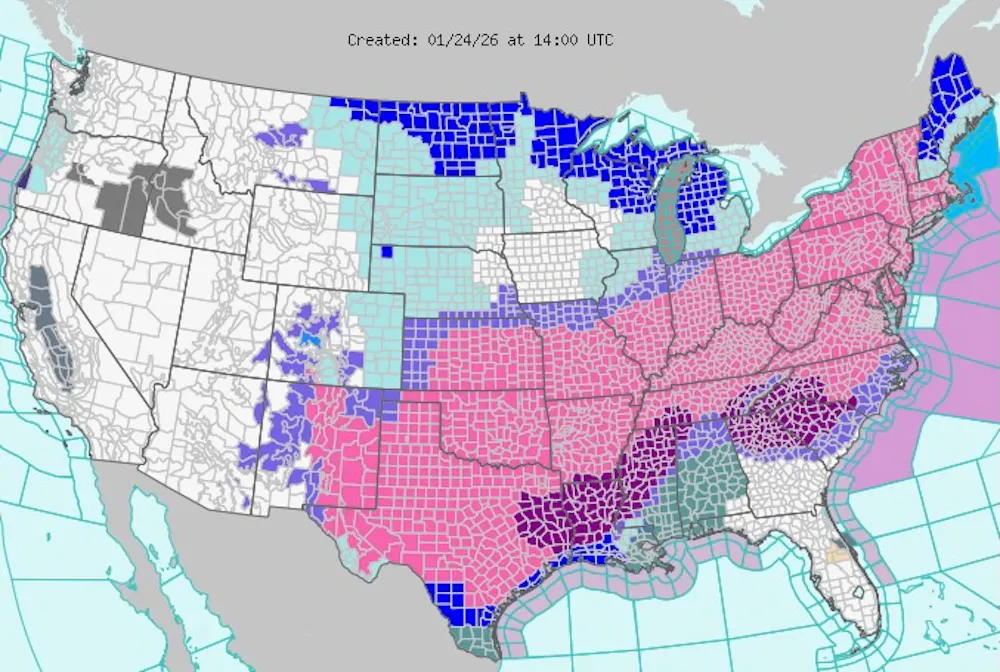
A map of storm warnings on Jan. 24, 2026.
The National Weather Service issued severe storm warnings (pink) on Jan. 24, 2026, for a large swath of the U.S. that could see sleet and heavy snow over the following days, along with ice storm warnings (dark purple) in several states and extreme cold warnings (dark blue). National Weather Service

Where does the polar vortex come in?

The fastest winds of the jet stream occur just below the top of the troposphere, which is the lowest level of the atmosphere and ends about seven miles above Earth’s surface. Weather systems are capped at the top of the troposphere, because the atmosphere above it becomes very stable.

The stratosphere is the next layer up, from about seven miles to about 30 miles. While the stratosphere extends high above weather systems, it can still interact with them through atmospheric waves that move up and down in the atmosphere. These waves are similar to the waves in the jet stream that cause it to dip southward, but they move vertically instead of horizontally.
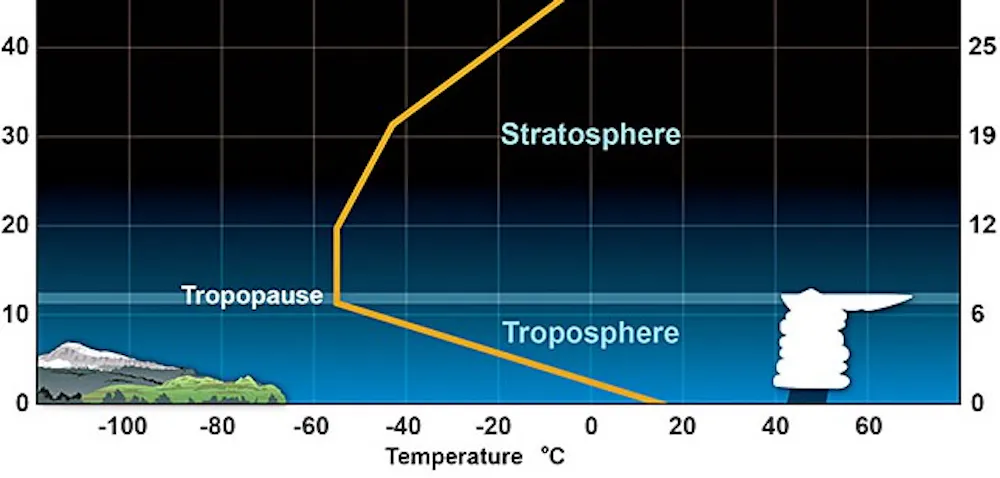
A chart shows how temperatures in the lower layers of the atmosphere change between the troposphere and stratosphere. Miles are on the right, kilometers on the left. NOAA

You’ve probably heard the term “polar vortex” used when an area of cold Arctic air moves far enough southward to influence the United States. That term describes air circulating around the pole, but it can refer to two different circulations, one in the troposphere and one in the stratosphere.

The Northern Hemisphere stratospheric polar vortex is a belt of fast-moving air circulating around the North Pole. It is like a second jet stream, high above the one you may be familiar with from weather graphics, and usually less wavy and closer to the pole.

Sometimes the stratospheric polar vortex can stretch southward over the United States. When that happens, it creates ideal conditions for the up-and-down movement of waves that connect the stratosphere with severe winter weather at the surface.
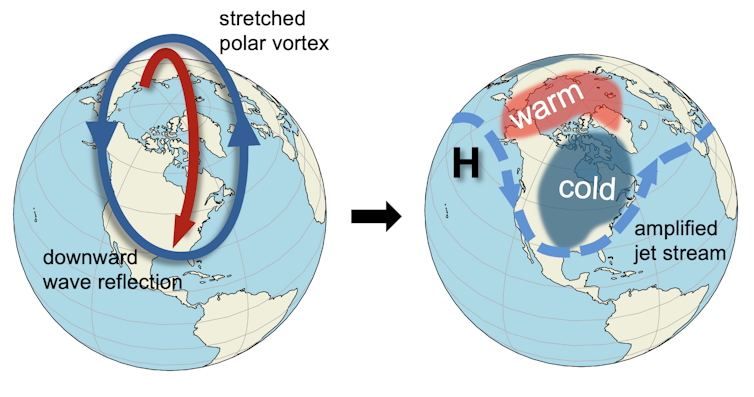
A stretched stratospheric polar vortex reflects upward waves back down, left, which affects the jet stream and surface weather, right. Mathew Barlow and Judah Cohen, CC BY

The forecast for the January storm showed a close overlap between the southward stretch of the stratospheric polar vortex and the jet stream over the U.S., indicating perfect conditions for cold and snow.

The biggest swings in the jet stream are associated with the most energy. Under the right conditions, that energy can bounce off the polar vortex back down into the troposphere, exaggerating the north-south swings of the jet stream across North America and making severe winter weather more likely.

This is what was happening in late January 2026 in the central and eastern U.S.

If the climate is warming, why are we still getting severe winter storms?

Earth is unequivocally warming as human activities release greenhouse gas emissions that trap heat in the atmosphere, and snow amounts are decreasing overall. But that does not mean severe winter weather will never happen again.

Some research suggests that even in a warming environment, cold events, while occurring less frequently, may still remain relatively severe in some locations.

One factor may be increasing disruptions to the stratospheric polar vortex, which appear to be linked to the rapid warming of the Arctic with climate change.
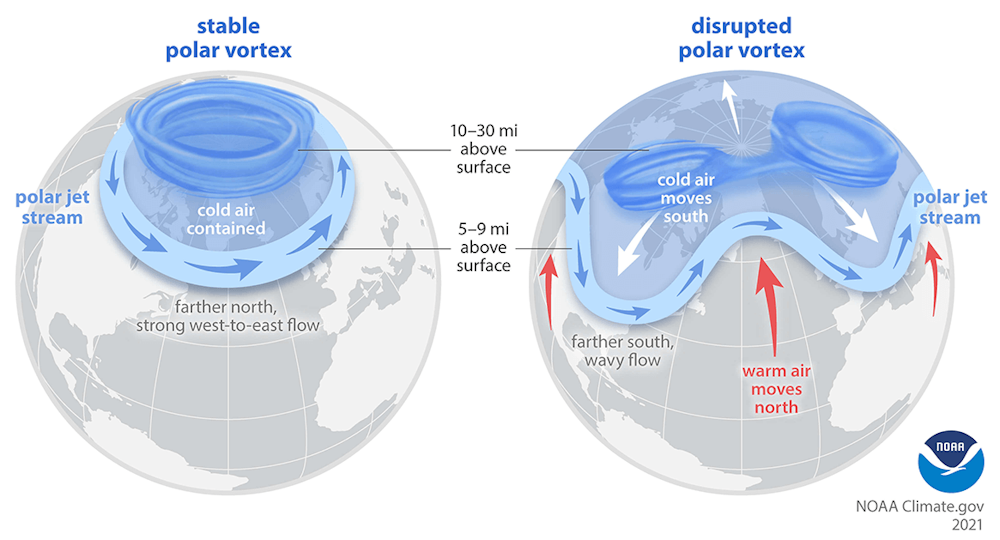
Two globes, one showing a stable polar vortex and the other a disrupted version that brings brutal cold to the South.
The polar vortex is a strong band of winds in the stratosphere, normally ringing the North Pole. When it weakens, it can split. The polar jet stream can mirror this upheaval, becoming weaker or wavy. At the surface, cold air is pushed southward in some locations. NOAA

Additionally, a warmer ocean leads to more evaporation, and because a warmer atmosphere can hold more moisture, that means more moisture is available for storms. The process of moisture condensing into rain or snow produces energy for storms as well. However, warming can also reduce the strength of storms by reducing temperature contrasts.

The opposing effects make it complicated to assess the potential change to average storm strength. However, intense events do not necessarily change in the same way as average events. On balance, it appears that the most intense winter storms may be becoming more intense.

A warmer environment also increases the likelihood that precipitation that would have fallen as snow in previous winters may now be more likely to fall as sleet and freezing rain.

There are still many questions

Scientists are constantly improving the ability to predict and respond to these severe weather events, but there are many questions still to answer.

Much of the data and research in the field relies on a foundation of work by federal employees, including government labs like the National Center for Atmospheric Research, known as NCAR, which has been targeted by the Trump administration for funding cuts. These scientists help develop the crucial models, measuring instruments and data that scientists and forecasters everywhere depend on.

This article, originally published Jan. 24, 2026, has been updated with details from the weekend storm.The Conversation

Mathew Barlow, Professor of Climate Science, UMass Lowell and Judah Cohen, Climate scientist, Massachusetts Institute of Technology (MIT)

This article is republished from The Conversation under a Creative Commons license. Read the original article.

  • 54
  • 55
  • 56
  • 57
  • 58
  • 59
  • 60
  • 61
  • 62
  • 63

Community

  • Sheriff’s Activities League and Clearlake Bassmasters offer youth fishing clinic

  • City Nature Challenge takes place April 24 to 27

Public Safety

  • Lakeport Police logs: Wednesday, Feb. 11

  • Lakeport Police logs: Tuesday, Feb. 10

Education

  • Ramos measure requiring school officer training in use of anti-opioid drug moves forward

  • Lake County Chapter of CWA announces annual scholarships 

Health

  • California ranks 24th in America’s Health Rankings Annual Report from United Health Foundation

  • Healthy blood donors especially vital during active flu season

Business

  • Employment law summit takes place March 9

  • Two Lake County Mediacom employees earn company’s top service awards

Obituaries

  • Terry Knight

  • Ellen Thomas

Opinion & Letters

  • Who should pay for AI’s power? Not California ratepayers

  • Crandell: Supporting nephew for reelection in supervisorial race

Veterans

  • State honors fallen chief warrant officer killed in conflict in Iran

  • CalVet and CSU Long Beach team up to improve data collection related to veteran suicides

Recreation

  • April Audubon program will show how volunteers can help monitor local osprey nests

  • First guided nature walk of spring at Anderson Marsh State Historic Park April 11

  • Second Saturday guided nature walks continue at Anderson Marsh State Historic Park

  • Wet weather trail closure in effect on Upper Lake Ranger District

Religion

  • Kelseyville Presbyterian Church plans Easter service

  • Easter ‘Sonrise’ Service returns to Xabatin Community Park

Arts & Life

  • ‘CIA’ delves into the shadowy world of an espionage thriller

  • ‘War Machine’ shifts the battlefield into uncharted territory

Government & Politics

  • Lake County Democratic Central Committee endorses Falkenberg

  • Crandell launches reelection campaign plans March 15 event

Legals

  • April 23 hearing on Lake Coco Farms Major Use Permit

  • NOTICE OF 30-DAY PUBLIC COMMENT PERIOD & NOTICE OF PUBLIC HEARING

How to resolve AdBlock issue?
Refresh this page