 How to resolve AdBlock issue?
Recreation
- Details
- Written by: California Department of Fish and Wildlife
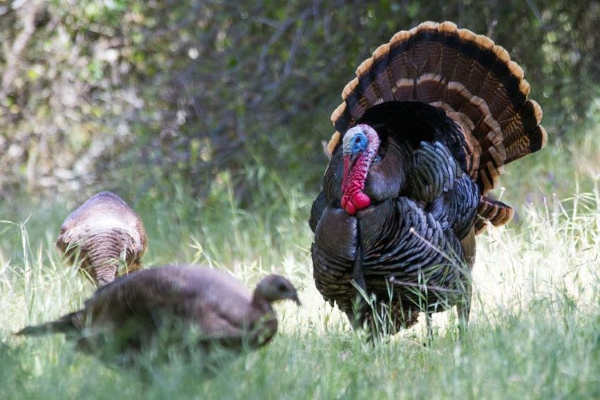
Can I use a 10-gauge shotgun to hunt turkey?
Q: Can I use a 10-gauge shotgun to hunt turkey?
A: Yes. California Code of Regulations (CCR), Title 14, section 311(a) authorizes use of a shotgun, 10-gauge or smaller, using shot shells only and incapable of holding more than three shells in the magazine and chamber combined. If a plug is used to reduce the capacity of a magazine per the requirements of this section, the plug must be made of one-piece construction and incapable of removal without disassembling the gun.
While it’s legal to hunt turkey with a 10-gauge shotgun, we’d like to share some additional perspective. Keep in mind that one of the most enjoyable elements of turkey hunting is coaxing the bird into your decoys, or concealed position, to get a close shot. With experience, practice and patience, you’ll be able to get birds in close enough to take them with a firearm as simple as a .410.
California's general spring turkey season opened statewide on March 25 and runs through April 30. Archery season follows from May 1-14 and runs concurrently with the junior hunt period. Shooting hours for spring turkeys are one half-hour before sunrise to 5 p.m. A valid hunting license and upland game bird validation are required to hunt wild turkeys. Hunting licenses can be purchased on CDFW’s Online License Sales and Services webpage.
Distinctive jellyfish
Q: I read about Velella velella washing up on beaches along the California coastline. Are they dangerous?
A: No, they are not dangerous. Velella velella, commonly known as By-the-wind sailors, are a distinctive jellyfish. Their bodies have a clear, chitinous semicircular to triangular sail which sticks up above the water with a blue float beneath made of concentric circles of gas-filled chambers, per Scripps Institution of Oceanography.
Velella velella cannot actively control their direction — they “sail” on the winds and, in the correct conditions, will wash ashore if blown too close. This happens occasionally in California and along the west coast. The species is relatively common, but they are typically only seen onshore during events like this.
For California Department of Fish and Wildlife (CDFW) marine news and information visit the department’s Marine Region webpage.
Streambeds and creeks
Q: The recent storms caused a levee near a creek in my community to break which caused flooding. We didn’t know if we needed permission from CDFW to clear the creek. What are the rules for homeowners taking action and clearing debris from streambeds and creeks?
A: We appreciate you checking in on this. Under California Fish and Game Code (FGC) section 1610, emergency work in streams does not require advance notification to CDFW. "Emergency" is defined as a sudden, unexpected occurrence involving a clear and imminent danger, demanding immediate action to prevent or mitigate loss of, or damage to, life, health, property or essential public services, per Public Resources Code section 21060.3.
Please note that:
• Emergency actions can occur in advance of the actual damaging event;
• Emergency actions may also include necessary subsequent actions (e.g. debris removal) that followed an immediate emergency (e.g. flooding);
• Entities must notify CDFW in writing within 14 days after beginning the emergency work; and CDFW is available to assist with any related questions. Please contact the Regional Manager of the applicable Regional Office.
• Also see from CDFW’s website: more information regarding the emergency notification process and more information about CDFW’s streambed alteration program in general.
For non-emergency projects, notification to CDFW may be required, per FGC section 1602. Notification would be followed by issuance of a Lake or Streambed Alteration Agreement for the project. CDFW recommends contacting the Regional Office associated with the location of your project if you have any questions about the permitting process for Lake or Streambed Alterations.
- Details
- Written by: Elizabeth Larson
The April nature walk will be led by Henry Bornstein, a certified California Naturalist and volunteer State Parks docent.
Guided nature walks at Anderson Marsh State Historic Park are held on the second Saturday of most months. The walks begin at 8:30 a.m.
There is no charge for the guided nature walks and parking is free for those attending.
No pets are permitted on the park trails. The route we will take on Saturday will depend on the weather and the condition of the trails.
Bring binoculars and meet in the parking lot at 8:15 a.m. for time to experience the early morning wildlife that can be found in the Ranch House and Barn complex yard. The walk will begin at 8:30 a.m.
Everyone is invited to take a walk in the park and experience the benefits of getting out into nature for some healthy exercise.
Rain will cancel the walk.
Anderson Marsh State Historic Park is located on Highway 53, between Lower Lake and Clearlake.
- Details
- Written by: CALIFORNIA DEPARTMENT OF FISH AND WILDLIFE
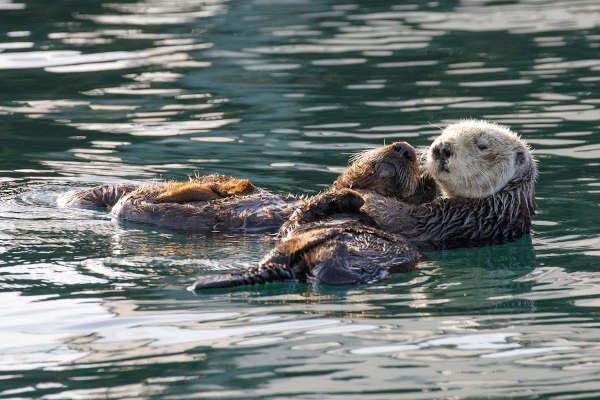
Does CDFW offer any tax-deductible donation options that help conserve wildlife?
Q: Does CDFW offer any tax-deductible donation options that help conserve wildlife?
A: Yes, thank you for wanting to help native and endangered plants, animals and fish! California taxpayers have the option to help one or all three of California Department of Fish and Wildlife’s (CDFW) tax check-off funds when filing their state income tax return:
1) The Rare and Endangered Species Preservation Voluntary Tax Contribution Program (Line 403 on Tax Form 540) supports conservation actions that help protect hundreds of rare, threatened and endangered plants and animals within our state.
2) The California Sea Otter Voluntary Tax Contribution Fund (Line 410 on Tax Form 540) supports CDFW scientists investigating causes of sea otter mortality and reasons why the species is not thriving in California. A portion of the funding goes to State Coastal Conservancy projects which help protect California’s sea otter population.
3) The Native California Wildlife Rehabilitation Voluntary Tax Contribution Fund (Line 439 on Tax Form 540) helps sick, injured and orphaned wildlife by supporting permitted wildlife rehabilitation facilities through a new CDFW grants program.
Everything you need to know to complete your donation can be found on CDFW’s Voluntary Tax Contribution Funds webpage. We truly appreciate your positive impact on key issues affecting California’s native species!
Rockfish identification
Q: How do I know if I’ve caught a copper, quillback or vermilion rockfish?
A: This is an important question because new regulations to help protect depleted stocks of copper and quillback rockfishes go into effect this year. In addition to the new season and depth regulations, CDFW reminds anglers that there is still a one-fish sub-bag limit for both copper rockfish and quillback rockfish, and a four-fish sub-bag limit for vermilion rockfish.
While it can be challenging to identify rockfish, anglers are responsible for properly identifying the species they catch.
CDFW has developed numerous fish identification resources for anglers including flyers to help distinguish copper, quillback and vermilion rockfishes from similar looking species:
Copper rockfish, canary rockfish and gopher rockfish identification
Quillback rockfish, China rockfish and black-and-yellow rockfish identification
Vermilion rockfish, canary rockfish and yelloweye rockfish identification
The Pacific States Marine Fisheries Commission’s RecFIN website has additional fish identification materials. Visit CDFW’s Groundfish webpage for more information including frequently asked questions.
Albino rattlesnakes
Q: I’m an out-of-state licensed reptile breeder and I have a potential customer in California who wants to legally acquire captive bred albino Western Diamondback rattlesnakes (Crotalus atrox). I read that they might be a restricted species. Would the customer need a permit to purchase the snakes?
A: No, a permit would not be necessary in this case. However, we appreciate you checking because the regulations are complicated. First, Crotalus atrox, while native to California, isn’t a restricted species. Currently, there are no native amphibians or reptiles that are a restricted species per California Code of Regulations (CCR), Title 14, sections 671(c)(3) and 671(c)(7). Note that the term "native" refers to all individuals from species and subspecies indigenous to California regardless of whether they are captive bred or from outside the state per CCR, Title 14, section 1.67.
Second, CCR, Title 14, section 40(a) states that importation of native California amphibians and reptiles is prohibited without permission from CDFW. That permission is afforded through various permits and licenses depending on the purpose of the importation, but the only one that currently applies to the pet trade is a Native Reptile Propagation Permit issued per CCR, Title 14, section 43. That section is limited to the three species of snakes that may be commercially bred: Lichanura orcutti, Lampropeltis californiae, and Pituophis catenifer (subsection 43(c)). Additionally, captively bred albino native reptiles are exempt from the requirement to possess a permit to purchase, breed, and sell (subsection 43(a)(7)), and they can be imported and exported without a permit from CDFW.
Third, note that albinos are defined as individual native reptiles lacking normal body pigment and having red or pink eyes. Therefore, if your albinos do not meet both specifications they would not be exempted from the importation prohibition in CCR, Title 14, section 40(a).
In summary, as long as your albino rattlesnakes meet the physical description in the regulations, they are exempt from the prohibition on importation and the requirement of the recipient to purchase a propagation permit. However, note that some local jurisdictions have ordinances against possession of venomous animals, so the customer should check to see if they live in one of those areas.
Answer provided by CDFW Amphibian and Reptile Conservation Coordinator Laura Patterson.
- Details
- Written by: California Department of Fish and Wildlife
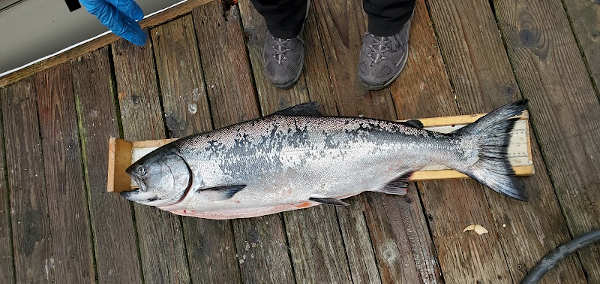
On Friday, on recommendation from California and Oregon agency representatives and industry advisors, the National Marine Fisheries Service took inseason action to cancel ocean salmon fishery openers that were scheduled between Cape Falcon, Ore., and the U.S./Mexico border through May 15.
The sport fishery had been scheduled to open off California in most areas on April 1. The actions were taken to protect Sacramento River fall Chinook, which returned to the Central Valley in 2022 at near-record low numbers, and Klamath River fall Chinook, which had the second lowest abundance forecast since the current assessment method began in 1997.
The Pacific Fishery Management Council (PFMC) has produced three regulatory options (PDF) for the May 16, 2023, through May 15, 2024, time period. None of the three options would authorize commercial or ocean salmon sport fishing off California until April 2024.
The alternatives were approved by the PFMC for public review on Friday.
On March 21, 2023, the PFMC will hold a public hearing in Santa Rosa to receive public comment on the three proposed regulatory alternatives. The PFMC will then meet April 1-7 in Foster City to adopt final regulations.
More information regarding the PFMC meetings and options can be found on the PFMC website at www.pcouncil.org.