How to resolve AdBlock issue?
Refresh this page
How to resolve AdBlock issue?
Refresh this page
Lake County News,California
  • Home
    • Registration Form
  • News
    • Community
      • Obituaries
      • Letters
      • Commentary
    • Education
    • Veterans
    • Police Logs
    • Business
    • Recreation
    • Health
    • Religion
    • Legals
    • Arts & Life
    • Regional
  • Calendar
  • Contact us
    • FAQs
    • Phones, E-Mail
    • Subscribe
  • Advertise Here
  • Login
How to resolve AdBlock issue?
Refresh this page
How to resolve AdBlock issue?
Refresh this page

News

Clear Lake boating restrictions lifted due to decreased lake levels

LAKE COUNTY, Calif. — The Lake County Water Resources Department, Lakebed Management and Lake County Sheriff’s Department Marine Patrol said Friday that boating restrictions previously imposed due to high lake levels have been lifted.

Ordinance 3065 mandates idle speed when boating within one-quarter mile or less from the shore.

As Clear Lake has dropped below the required level of 8.0 feet on the Rumsey scale — the special measure used for Clear Lake — for more than 24 hours, Ordinance 3065 is now lifted, officials reported.

Boaters are no longer required to operate at idle speed and can resume normal boating activities, effective immediately.

For specific regulations and details on normal boating operations, please refer to the Chapter 15 – Recreation Ordinance on the Municode website.

The agencies reminded all boaters to continue exercising caution while on Clear Lake. Floating and submerged debris hazards, resulting from winter atmospheric river storm events may still be present.

These hazards include trees, branches, floating docks, abandoned or detached boats, trash, and other objects that can pose a risk to boaters.

Boaters are encouraged to remain vigilant, be aware of their surroundings, and maintain a safe speed when navigating Clear Lake, especially during this time of year.

For any inquiries regarding this update or to report hazards such as debris, floating docks or missing or found hazard buoys, please contact the Water Resources Department at 707-263-2344 or email at This email address is being protected from spambots. You need JavaScript enabled to view it..
Details
Written by: Elizabeth Larson
Published: 27 April 2024

Nearsightedness is at epidemic levels – and the problem begins in childhood


Nearsightedness is also known as myopia. Witthaya Prasongsin/Moment via Getty Images

Myopia, or the need for corrected vision to focus or see objects at a distance, has become a lot more common in recent decades. Some even consider myopia, also known as nearsightedness, an epidemic.

Optometry researchers estimate that about half of the global population will need corrective lenses to offset myopia by 2050 if current rates continue – up from 23% in 2000 and less than 10% in some countries.

The associated health care costs are huge. In the United States alone, spending on corrective lenses, eye tests and related expenses may be as high as US$7.2 billion a year.

What explains the rapid growth in myopia?

I’m a vision scientist who has studied visual perception and perceptual defects. To answer that question, first let’s examine what causes myopia – and what reduces it.

A closer look at myopia.

How myopia develops

While having two myopic parents does mean you’re more likely to be nearsighted, there’s no single myopia gene. That means the causes of myopia are more behavioral than genetic.

Optometrists have learned a great deal about the progression of myopia by studying visual development in infant chickens. They do so by putting little helmets on baby chickens. Lenses on the face of the helmet cover the chicks’ eyes and are adjusted to affect how much they see.

Just like in humans, if visual input is distorted, a chick’s eyes grow too large, resulting in myopia. And it’s progressive. Blur leads to eye growth, which causes more blur, which makes the eye grow even larger, and so on.

Two recent studies featuring extensive surveys of children and their parents provide strong support for the idea that an important driver of the uptick in myopia is that people are spending more time focusing on objects immediately in front of our eyes, whether a screen, a book or a drawing pad. The more time we spend focusing on something within arm’s length of our faces, dubbed “near work,” the greater the odds of having myopia.

So as much as people might blame new technologies like smartphones and too much “screen time” for hurting our eyes, the truth is even activities as valuable as reading a good book can affect your eyesight.

Outside light keeps myopia at bay

Other research has shown that this unnatural eye growth can be interrupted by sunlight.

A 2022 study, for example, found that myopia rates were more than four times greater for children who didn’t spend much time outdoors – say, once or twice a week – compared with those who were outside daily. At the same time, kids who spent more than three hours a day while not at school reading or looking at a screen close-up were four times more likely to have myopia than those who spent an hour or less doing so.

In another paper, from 2012, researchers conducted a meta-analysis of seven studies that compared duration of time spent outdoors with myopia incidence. They also found that more time spent outdoors was associated with lower myopia incidence and progression. The odds of developing myopia dropped by 2% for each hour spent outside per week.

Other researchers have reported similar effects and argued for much more time outdoors and changes in early-age schooling to reduce myopia prevalence.

‘Why so many people need glasses now.’

What’s driving the epidemic

That still doesn’t explain why it’s on the rise so rapidly.

Globally, a big part of this is due to the rapid development and industrialization of countries in East Asia over the last 50 years. Around that time, young people began spending more time in classrooms reading and focusing on other objects very close to their eyes and less time outdoors.

This is also what researchers observed in the North American Arctic after World War II, when schooling was mandated for Indigenous people. Myopia rates for Inuit went from the single digits before the 1950s to upwards of 70% by the 1970s as all children began attending schools for the first time.

Countries in Western Europe, North America and Australia have shown increased rates of myopia in recent years but nothing approaching what has been observed recently in China, Japan, Singapore and a few other East Asian countries. The two main factors identified as leading to increased myopia are increased reading and other activities that require focusing on an object close to one’s eyes and a reduction in time spent outdoors.

The surge in myopia cases will likely have its worst effects 40 or 50 years from now because it takes time for the young people being diagnosed with nearsightedness now to experience the most severe vision problems.

Treating myopia

Fortunately, just a few minutes a day with glasses or contact lenses that correct for blur stops the progression of myopia, which is why early vision testing and vision correction are important to limit the development of myopia. Eye checks for children are mandatory in some countries, such as the U.K. and now China, as well as most U.S. states.

People with with high myopia, however, have increased risk of blindness and other severe eye problems, such as retinal detachment, in which the retina pulls away from the the back of the eye. The chances of myopia-related macular degeneration increase by 40% for each diopter of myopia. A diopter is a unit of measurement used in eye prescriptions.

But there appear to be two sure-fire ways to offset or delay these effects: Spend less time focusing on objects close to your face, like books and smartphones, and spend more time outside in the bright, natural light. Given the first one is difficult advice to take in our modern age, the next best thing is taking frequent breaks – or perhaps spend more time reading and scrolling outside in the sun.The Conversation

Andrew Herbert, Professor of Psychology, Visual Perception, Rochester Institute of Technology

This article is republished from The Conversation under a Creative Commons license. Read the original article.
Details
Written by: Andrew Herbert, Rochester Institute of Technology
Published: 27 April 2024

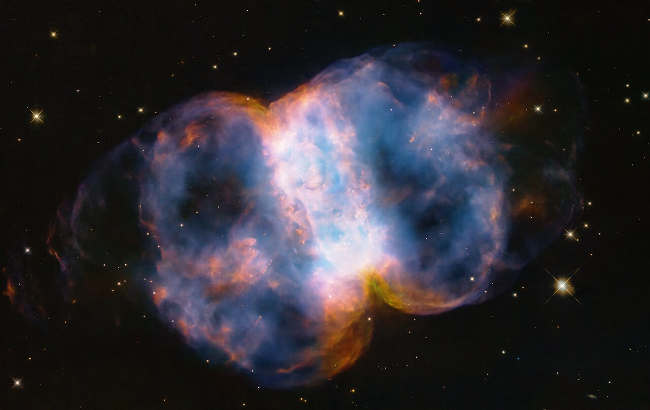
Space News: Hubble celebrates 34th anniversary with a look at the Little Dumbbell Nebula

Little Dumbbell Nebula (M76). Image credit: NASA, ESA, STScI, A. Pagan (STScI).

In celebration of the 34th anniversary of the launch of the legendary NASA/ESA Hubble Space Telescope on April 24, astronomers took a snapshot of the Little Dumbbell Nebula (also known as Messier 76, M76, or NGC 650/651) located 3400 light-years away in the northern circumpolar constellation Perseus.

The photogenic nebula is a favorite target of amateur astronomers.

M76 is classified as a planetary nebula, an expanding shell of glowing gases that were ejected from a dying red giant star. The star eventually collapses to an ultra-dense and hot white dwarf.

A planetary nebula is unrelated to planets, but has that name because astronomers in the 1700s using low-power telescopes thought this type of object resembled a planet.

M76 is composed of a ring, seen edge-on as the central bar structure, and two lobes on either opening of the ring. Before the star burned out, it ejected the ring of gas and dust. The ring was probably sculpted by the effects of the star that once had a binary companion star.

This sloughed-off material created a thick disc of dust and gas along the plane of the companion’s orbit. The hypothetical companion star isn’t seen in the Hubble image, and so it could have been later swallowed by the central star. The disc would be forensic evidence for that stellar cannibalism.

The primary star is collapsing to form a white dwarf. It is one of the hottest stellar remnants known, at a scorching 120 000 degrees Celsius, 24 times our Sun’s surface temperature. 
The sizzling white dwarf can be seen as a pinpoint in the center of the nebula. A star visible in projection beneath it is not part of the nebula.

Pinched off by the disc, two lobes of hot gas are escaping from the top and bottom of the ‘belt’ along the star’s rotation axis that is perpendicular to the disc. They are being propelled by the hurricane-like outflow of material from the dying star, tearing across space at two million miles per hour. That’s fast enough to travel from Earth to the Moon in a little over seven minutes!

This torrential ‘stellar wind’ is plowing into cooler, slower-moving gas that was ejected at an earlier stage in the star’s life, when it was a red giant. Ferocious ultraviolet radiation from the super-hot star is causing the gases to glow. The red colour is from nitrogen, and blue is from oxygen.


Given that our solar system is 4.6 billion years old, the entire nebula is a flash in the pan by cosmological timekeeping. It will vanish in about 15 000 years.


34 years of science and imagery

Since its launch in 1990 Hubble has made 1.6 million observations of over 53 000 astronomical objects. To date, the Mikulski Archive for Space Telescopes at the Space Telescope Science Institute in Baltimore, Maryland holds 184 terabytes of processed data that are science-ready for use by astronomers around the world to use for research and analysis.

A European mirror of the public data is hosted at ESA's European Space Astronomy Centre (ESAC), in the European Hubble Space Telescope (eHST) Science Archive.

Since 1990, 44 000 science papers have been published from Hubble observations. This includes a record 1056 papers published in 2023, of which 409 were led by authors in the ESA Member States. The demand for using Hubble is so high it is currently oversubscribed by a factor of six.

Throughout its past year of science operations, new discoveries made using Hubble include finding water in the atmosphere of the smallest exoplanet to date, spotting a bizarre cosmic explosion far from any host galaxy, following spokes on the rings of Saturn and finding the unexpected home of the most distant and powerful fast radio burst yet seen.

Hubble’s studies of the asteroid Dimorphos, the target of a deliberate NASA spacecraft collision in September 2022 to alter its trajectory, continued with the detection of boulders released by the impact.

Hubble has also continued to provide spectacular images of celestial targets including spiral galaxies, globular clusters and star-forming nebulae. A newly forming star was the source of a cosmic light show. Hubble imagery was also combined with infrared observations from the NASA/ESA/CSA James Webb Space Telescope to create one of the most comprehensive views of the Universe ever, an image of galaxy cluster MACS 0416.

Most of Hubble’s discoveries were not anticipated before launch, such as supermassive black holes, the atmospheres of exoplanets, gravitational lensing by dark matter, the presence of dark energy, and the abundance of planet formation among stars.

Hubble will continue research in those domains, as well as capitalizing on its unique ultraviolet-light capability to examine such things as Solar System phenomena, supernova outbursts, the composition of exoplanet atmospheres, and dynamic emission from galaxies.

And Hubble investigations continue to benefit from its long baseline of observations of Solar System objects, variable stellar phenomena and other exotic astrophysics of the cosmos.

The performance characteristics of the James Webb Space Telescope were designed to be uniquely complementary to Hubble, and not a substitute. Future Hubble research also will take advantage of the opportunity for synergies with Webb, which observes the Universe in infrared light.

Combined together, the complementary wavelength coverage of the two space telescopes expands on groundbreaking research in such areas as protostellar discs, exoplanet composition, unusual supernovae, cores of galaxies and chemistry of the distant Universe.

The Hubble Space Telescope has been operating for over three decades and continues to make ground-breaking discoveries that shape our fundamental understanding of the Universe.

The Hubble Space Telescope is a project of international cooperation between ESA and NASA.
Details
Written by: ESA/Hubble
Published: 27 April 2024

Lake County jobless rate drops in March

LAKE COUNTY, Calif. — With spring’s arrival this year, the unemployment rate in Lake County showed improvement.

The California Employment Development Department’s latest report on joblessness in California showed a positive pattern.

Lake County’s March jobless rate was 6.6%, down from 7.2% in February and 7.4% in January. The March 2023 rate was slightly better, at 6.3%.

For California as a whole, the EDD reported that the state unemployment rate held steady at 5.3% for a second month. Like Lake County, California had a better jobless rate in March of 2023, at 4.7%.

At the same time, the U.S. Bureau of Labor Statistics reported that the nation’s March jobless rate was 3.8%, down from 3.9% in February. The United States has a total unemployment rate of 3.5% in March of 2023.

While Lake County’s jobless rate went down — with 200 fewer people unemployed in March than in February — it showed declines in jobs across nearly every category. Only mining, logging and construction, at 1.2%, and leisure and hospitality, 1.8%, showed growth, while all other categories either declined or stayed flat.

The civilian labor force numbered 29,170 individuals in March, compared to 29,760 in February and 28,880 in March of 2023.

On a statewide level, the EDD said California’s employers added 28,300 nonfarm payroll jobs in March. Despite the mostly weather-related job loss of 6,600 in February — revised down by 3,200 — March continued a job growth trend over the last eight months that totals 205,200 jobs, a monthly average increase of 25,700 jobs.

The EDD said California payroll jobs totaled 17,996,200 in March, up 28,300 from February and up 217,700 from March of last year.

California’s job market expansion is now 47 months long. Since April 2020, California has gained 3,062,700 jobs, or about 65,200 per month on average, the EDD reported.

Seven of California's 11 industry sectors gained jobs in March with private education and health services (+13,600) posting the largest month-over gain for the third month in a row, the EDD said. This was due in part to payroll additions in social assistance, which saw noticeable growth with in-home support service workers.

The state said construction bounced back after a weather-related decrease last month with a gain of 4,600 jobs. The industry is up 33,900 jobs over the year.

Manufacturing dropped 5,300 jobs, experiencing the largest month-over job reduction with losses in sectors including machinery manufacturing and food manufacturing. In Lake County, manufacturing showed no growth in March but was 6.3% up over the year.

The EDD said California’s latest unemployment rate is in line with the 5% average rate over five years leading into the pandemic — during one of the longest economic expansions in state history.

For March, Lake County’s jobless rate earned it a rank of No. 35 out of California’s 58 counties, the same as it had in February.

Lake’s neighboring county jobless rates and ranks were: Colusa, 19.2%, No. 58; Glenn, 7.6%, No. 44; Mendocino, 5.7%, No. 27; Napa and Sonoma counties, tied at 4.2%, No. 8; and Yolo, 5.8%, No. 29.

San Mateo County continues to hold the lowest unemployment rate in California, 3.5%, an improvement over the 3.7% rate reported for February.

In related data that figures into the state’s unemployment rate, there were 446,130 people certifying for Unemployment Insurance benefits during the March 2024 sample week. That compares to 425,760 people in February and 414,119 people in March 2023.

The EDD said a total of 41,000 initial claims for unemployment were processed in the March 2024 sample week, which was a month-over decrease of 260 claims from February and a year-over decrease of 5,792 claims from March 2023.

Email Elizabeth Larson at This email address is being protected from spambots. You need JavaScript enabled to view it.. Follow her on Twitter, @ERLarson, or Lake County News, @LakeCoNews.
Details
Written by: Elizabeth Larson
Published: 26 April 2024
  1. Thompson, Huffman address California insurance crisis
  2. Yuba Community College District reports on completion rates
  3. For millions of Americans, high-speed internet is unavailable or unaffordable − a telecommunications expert explains how to bring broadband to the places that need it the most

Subcategories

Community

  • 694
  • 695
  • 696
  • 697
  • 698
  • 699
  • 700
  • 701
  • 702
  • 703
How to resolve AdBlock issue?
Refresh this page
Copyright © 2026 Lake County News,California. All Rights Reserved.