How to resolve AdBlock issue?
Refresh this page
How to resolve AdBlock issue?
Refresh this page
Lake County News,California
  • Home
    • Registration Form
  • News
    • Community
      • Obituaries
      • Letters
      • Commentary
    • Education
    • Veterans
    • Police Logs
    • Business
    • Recreation
    • Health
    • Religion
    • Legals
    • Arts & Life
    • Regional
  • Calendar
  • Contact us
    • FAQs
    • Phones, E-Mail
    • Subscribe
  • Advertise Here
  • Login
How to resolve AdBlock issue?
Refresh this page
How to resolve AdBlock issue?
Refresh this page

News

Large retailers don’t have smokestacks, but they generate a lot of pollution − and states are starting to regulate it


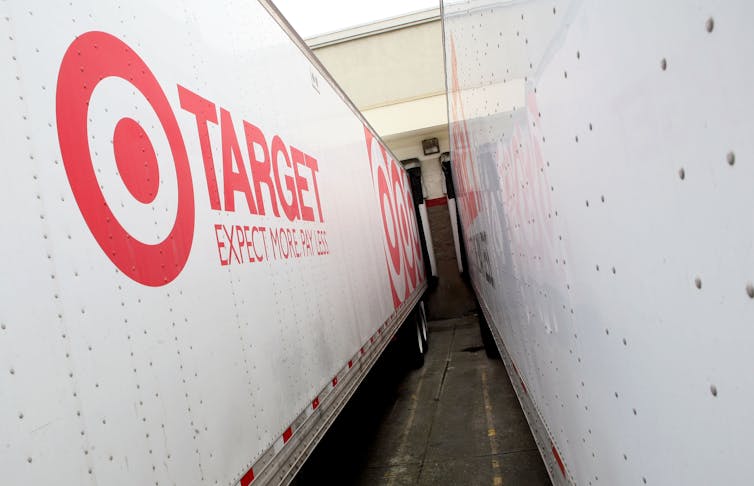
One of many trucks that move Target goods nationwide. Justin Sullivan/Getty Images

Did you receive a mail-order package this week? Carriers in the U.S. shipped 64 packages for every American in 2022, so it’s quite possible.

That commerce reflects the expansion of large-scale retail in recent decades, especially big-box chains like Walmart, Target, Best Buy and Home Depot that sell goods both in stores and online. This has led to the growth of distribution centers that fulfill these orders. While mail-order commerce is convenient, these centers also have harmful impacts, including traffic congestion and air and water pollution.

I study environmental history, and I am part of a group of scholars examining the environmental impacts of big-box stores like Walmart, Target, REI and Bass Pro Shops. Sustainability is a hot topic in the retail sector, but my research on the history of Target – the sixth-largest retailer in the U.S. – shows how retail companies have largely escaped the kinds of environmental regulations that affect other sectors such as manufacturing.

California is leading efforts to regulate harmful impacts of retail distribution centers.

Indirect pollution sources

Doing business on Target’s scale, with US$108 billion in sales in 2022, creates a big physical footprint. The company has nearly 2,000 stores in the U.S. that cover over 240 million square feet of retail space, not including parking lots. Its 55 supply chain facilities add an additional 60 million square feet. For perspective, 1 million square feet is slightly larger than 15 football fields.

Target, which originated as a dry goods company in 1902, has been a leading retail voice for over a century. The company played a prominent role in the 1970s as Congress expanded federal power to regulate air pollution nationwide under the Clean Air Act of 1970.

Target stores offer a diverse range of products, from clothing to home goods, groceries and electronics. About 75% of Americans live within 10 miles of a Target store.

This law gave the Environmental Protection Agency broad authority to identify and regulate air pollutants and to set air quality standards that would protect public health. To meet those standards, in the mid-1970s lawmakers and regulators considered adopting transportation controls that could address indirect pollution sources – entities that did not generate air pollution themselves but attracted large numbers of sources, such as cars and trucks, that did. Examples included airports, highways, sports stadiums and shopping centers.

Target’s parent company, Dayton Hudson, operated numerous shopping centers and other retail chains. One of its executives, George Hite, was a leading spokesperson against regulating indirect pollution sources.

From 1974-1977, Hite testified on behalf of large retail trade groups during a series of congressional hearings, arguing that the proposed regulations were unfair and would undercut sound planning. Hite asserted that because shopping centers were one-stop destinations for consumers, they actually reduced air pollution from consumers’ trips.

Ultimately, indirect source regulations did not become part of the Clean Air Act amendments of 1977. As a result, retail continued to expand, unconstrained by major federal environmental laws.

People walk toward a baseball park. A sign over the entrance reads 'Target Field,' with the Target Corporation's red bullseye symbol.
Fans enter Target Field in Minneapolis, Minn., before a game on Aug. 15, 2021. Target is based in Minneapolis-St. Paul and was the Twin Cities’ largest employer for many years. Joe Robbins/Icon Sportswire via Getty Images

Big-box boom

Big-box discount stores like Kmart, Walmart and Target began outcompeting shopping centers in the 1980s because of their low prices and convenience. The biggest chains expanded nationally, driving many smaller local stores out of business.

These companies relied on a new type of warehouse: the distribution center, which used computer technology to make supply chains more efficient. Compared with earlier warehouses, distribution centers were larger and focused on efficient movement of goods rather than storage.

In the 1990s, communities across the country began organizing to slow the expansion of big-box stores. Most efforts focused on opposing individual stores and ignored the rising number of distribution centers. One exception was in the Wisconsin town of Oconomowoc.

Located along I-94 between Madison and Milwaukee and surrounded by glacial lakes, Oconomowoc was a former vacation destination for wealthy Midwesterners that evolved into a commuter town. When Target announced in 1993 that it had selected Oconomowoc as the site for a new, million-plus-square-foot regional distribution center, residents quickly organized to preserve the area’s pastoral setting.

State and local officials refused to reconsider the deal they had reached with Target, which included grants and other tax subsidies. In response, opponents filed multiple lawsuits.

Plaintiffs cited the planned center’s environmental impacts, including potential threats to groundwater and air emissions from long-haul, diesel-fueled trucks. However, state and federal courts ultimately dismissed their cases. Judges ruled that the Clean Air Act did not attribute delivery truck emissions to the distribution center, and the Clean Water Act did not cover a retention pond that was planned to collect runoff from the center’s parking lot.


Probing retail’s environmental costs

Today, retail supply chain infrastructure is moving into urban areas. Target and other retailers are meeting new opposition, including pushback from environmental justice groups, which argue that these companies’ operations increase traffic and degrade air quality.

In a 2024 report, the nonprofit Environmental Defense Fund and ElectrifyNY, a coalition working to electrify transportation in New York state, found that 1 in 4 people statewide lived within half a mile of a retail distribution center, and that these facilities generated over 170,000 truck trips per day. The report endorsed proposed state legislation that would classify storage and distribution centers over 50,000 square feet as indirect pollution sources and require them to reduce transportation-related air emissions.

In Southern California, the powerful South Coast Air Quality Management District, which regulates regional air quality, has taken this step with Rule 2305. This regulation is the first in the U.S. to address emissions generated by trucks traveling to and from large warehouse facilities.

The rule focuses on reducing ozone, a major contributor to smog, and fine particulate matter. Both of these pollutants are formed from chemicals in diesel exhaust and are harmful to human health.

Rule 2305 was adopted in 2021 and survived a legal challenge from trucking companies in 2023. To avoid fines of up to $10,000 per day, hundreds of warehouse operators must earn points for taking steps from a list of actions to reduce local air pollution.

Options include using low-emission or electric vehicles and installing charging stations on-site, or placing air filters in local buildings. Point targets are based on each facility’s size, number of truck trips and other factors.


Shopping carts vs. smokestacks

Big-box retailers maintain that they can manage their facilities’ environmental impacts without government intervention or structural change. For example, Target touts investments to make its facilities more energy efficient and place solar panels on its stores and distribution centers. Yet, Target’s indirect emissions dwarf these gains.

For example, in 2022 the company generated nearly 6 million metric tons of carbon dioxide-equivalent greenhouse gas emissions in transporting goods from its distribution centers to consumers. Including emissions generated when suppliers shipped these goods to Target’s distribution network more than doubled this figure.

In comparison, the company estimated that the electricity it purchased to power its facilities in 2022 generated just over 1.5 million metric tons of carbon dioxide-equivalent emissions. Using this number as a base, I estimate that Target’s claim the same year of using 60% of electricity from renewable resources offset emissions by some 2.25 million metric tons.

And Target is only one of numerous retailers. According to a 2022 report by the World Retail Congress and Boston Consulting Group, this sector as a whole “has some way to go before it can claim truly green credentials. … Most [large retailers] have yet to put in place comprehensive sustainability agendas.”

The goods that consumers buy, and the ways in which they buy them, drastically affect the environment. In my view, the retail sector’s impacts on air, water, waste generation and Earth’s climate call for national-level responses. Big-box stores may not look like smoke-belching factories, but their companies’ operations affect the environment in ways that have become too big to ignore.The Conversation

Johnathan Williams, Assistant Professor of History, University of Northern Iowa

This article is republished from The Conversation under a Creative Commons license. Read the original article.


Details
Written by: Johnathan Williams, University of Northern Iowa
Published: 28 April 2024

Helping Paws: ‘Beau’ and the dogs

LAKE COUNTY, Calif. — Lake County Animal Care and Control has many great dogs wanting to meet you this week.

Dogs available for adoption this week include mixes of Alaskan husky, Anatolian shepherd, Australian shepherd, border collie, Chesapeake Bay retriever, Chihuahuas, German shepherd, hound, Labrador Retriever, mastiff, pit bull terrier, Rottweiler and terrier.

Dogs that are adopted from Lake County Animal Care and Control are either neutered or spayed, microchipped and, if old enough, given a rabies shot and county license before being released to their new owner. License fees do not apply to residents of the cities of Lakeport or Clearlake.

The dogs available this week include “Beau,” an Australian shepherd mix who went to the Board of Supervisors meeting last week.

Those dogs and the others shown on this page at the Lake County Animal Care and Control shelter have been cleared for adoption.

Call Lake County Animal Care and Control at 707-263-0278 or visit the shelter online for information on visiting or adopting.

The shelter is located at 4949 Helbush in Lakeport.

Email Elizabeth Larson at This email address is being protected from spambots. You need JavaScript enabled to view it.. Follow her on Twitter, @ERLarson, or Lake County News, @LakeCoNews.


Kennel#14's preview photo
Kennel#14

Kennel#9's preview photo
Kennel#9

Kennel#15's preview photo
Kennel#15

Kennel#20's preview photo
Kennel#20


A#124
Kennel #13's preview photo
Kennel #13

Kennel#25's preview photo
Kennel#25

Kennel #18's preview photo
Kennel #18

Kennel#4's preview photo
Kennel#4

Kennel#8's preview photo
Kennel#8

Kennel#24's preview photo
Kennel#24

 
Kennel#10's preview photo
Kennel#10

Kennel#12's preview photo
Kennel#12

Kennel#27(a)'s preview photo
Kennel#27(a)

Kennel#32's preview photo
Kennel#32

Kennel#17's preview photo
Kennel#17

Kennel#16(Beau)'s preview photo
Kennel#16(Beau)

Kennel#2's preview photo
Kennel#2

Kennel#5's preview photo
Kennel#5

Kennel#22's preview photo
Kennel#22

Kennel#29's preview photo
Kennel#29

Kennel#31a's preview photo
Kennel#31a

Kennel#31b's preview photo
Kennel#31b

Kennel#11a(Lucy)'s preview photo
Kennel#11a(Lucy)

Kennel#11b's preview photo
Kennel#11b


Kennel#19(Patron)'s preview photo
Kennel#19(Patron)

Kennel#3's preview photo
Kennel#3

 
Kennel#34's preview photo
Kennel#34
 
Details
Written by: Elizabeth Larson
Published: 28 April 2024

Space News: The Mars Sample Return mission has a shaky future, and NASA is calling on private companies for backup


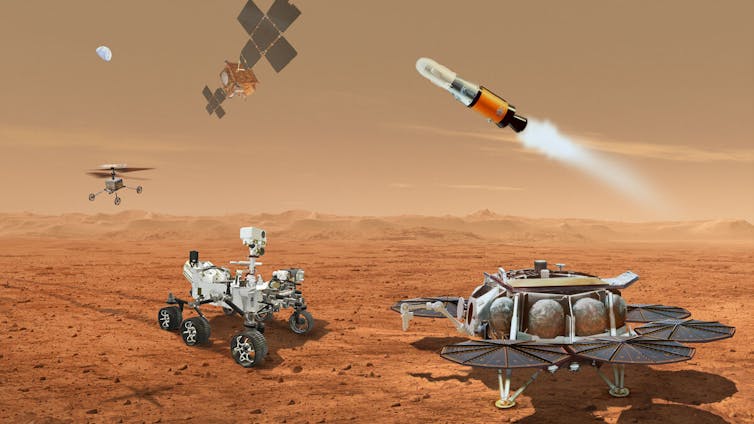
The equipment planned to help bring samples back from Mars. NASA/JPL

A critical NASA mission in the search for life beyond Earth, Mars Sample Return, is in trouble. Its budget has ballooned from US$5 billion to over $11 billion, and the sample return date may slip from the end of this decade to 2040.

The mission would be the first to try to return rock samples from Mars to Earth so scientists can analyze them for signs of past life.

NASA Administrator Bill Nelson said during a press conference on April 15, 2024, that the mission as currently conceived is too expensive and too slow. NASA gave private companies a month to submit proposals for bringing the samples back in a quicker and more affordable way.

As an astronomer who studies cosmology and has written a book about early missions to Mars, I’ve been watching the sample return saga play out. Mars is the nearest and best place to search for life beyond Earth, and if this ambitious NASA mission unraveled, scientists would lose their chance to learn much more about the red planet.

The habitability of Mars

The first NASA missions to reach the surface of Mars in 1976 revealed the planet as a frigid desert, uninhabitable without a thick atmosphere to shield life from the Sun’s ultraviolet radiation. But studies conducted over the past decade suggest that the planet may have been much warmer and wetter several billion years ago.

The Curiosity and Perseverance rovers have each shown that the planet’s early environment was suitable for microbial life.

They found the chemical building blocks of life and signs of surface water in the distant past. Curiosity, which landed on Mars in 2012, is still active; its twin, Perseverance, which landed on Mars in 2021, will play a crucial role in the sample return mission.

An overhead view of a sandy crater.
The Mars Jezero Crater, which scientists are searching for signs of ancient bacteria. ESA/DLR/FU Berlin, CC BY-SA

Why astronomers want Mars samples

The first time NASA looked for life in a Mars rock was in 1996. Scientists claimed they had discovered microscopic fossils of bacteria in the Martian meteorite ALH84001. This meteorite is a piece of Mars that landed in Antarctica 13,000 years ago and was recovered in 1984. Scientists disagreed over whether the meteorite really had ever harbored biology, and today most scientists agree that there’s not enough evidence to say that the rock contains fossils.

Several hundred Martian meteorites have been found on Earth in the past 40 years. They’re free samples that fell to Earth, so while it might seem intuitive to study them, scientists can’t tell where on Mars these meteorites originated. Also, they were blasted off the planet’s surface by impacts, and those violent events could have easily destroyed or altered subtle evidence of life in the rock.

There’s no substitute for bringing back samples from a region known to have been hospitable to life in the past. As a result, the agency is facing a price tag of $700 million per ounce, making these samples the most expensive material ever gathered.

A compelling and complex mission

Bringing Mars rocks back to Earth is the most challenging mission NASA has ever attempted, and the first stage has already started.

Perseverance has collected over two dozen rock and soil samples, depositing them on the floor of the Jezero Crater, a region that was probably once flooded with water and could have harbored life. The rover inserts the samples in containers the size of test tubes. Once the rover fills all the sample tubes, it will gather them and bring them to the spot where NASA’s Sample Retrieval Lander will land. The Sample Retrieval Lander includes a rocket to get the samples into orbit around Mars.

An animation showing the Mars Sample Return mission’s plan, as designed by the Jet Propulsion Laboratory.

The European Space Agency has designed an Earth Return Orbiter, which will rendezvous with the rocket in orbit and capture the basketball-sized sample container. The samples will then be automatically sealed into a biocontainment system and transferred to an Earth entry capsule, which is part of the Earth Return Orbiter. After the long trip home, the entry capsule will parachute to the Earth’s surface.

The complex choreography of this mission, which involves a rover, a lander, a rocket, an orbiter and the coordination of two space agencies, is unprecedented. It’s the culprit behind the ballooning budget and the lengthy timeline.

Sample return breaks the bank

Mars Sample Return has blown a hole in NASA’s budget, which threatens other missions that need funding.

The NASA center behind the mission, the Jet Propulsion Laboratory, just laid off over 500 employees. It’s likely that Mars Sample Return’s budget partly caused the layoffs, but they also came down to the Jet Propulsion Laboratory having an overfull plate of planetary missions and suffering budget cuts.

Within the past year, an independent review board report and a report from the NASA Office of Inspector General raised deep concerns about the viability of the sample return mission. These reports described the mission’s design as overly complex and noted issues such as inflation, supply chain problems and unrealistic costs and schedule estimates.

NASA is also feeling the heat from Congress. For fiscal year 2024, the Senate Appropriations Committee cut NASA’s planetary science budget by over half a billion dollars. If NASA can’t keep a lid on the costs, the mission might even get canceled.

Thinking out of the box

Faced with these challenges, NASA has put out a call for innovative designs from private industry, with a goal of shrinking the mission’s cost and complexity. Proposals are due by May 17, which is an extremely tight timeline for such a challenging design effort. And it’ll be hard for private companies to improve on the plan that experts at the Jet Propulsion Laboratory had over a decade to put together.

An important potential player in this situation is the commercial space company SpaceX. NASA is already partnering with SpaceX on America’s return to the Moon. For the Artemis III mission, SpaceX will attempt to land humans on the Moon for the first time in more than 50 years.

However, the massive Starship rocket that SpaceX will use for Artemis has had only three test flights and needs a lot more development before NASA will trust it with a human cargo.

A long, cylindrical rocket with a plume of flame coming from its end launches into the cloudy sky.
SpaceX’s Starship rocket, the most powerful commercial rocket. AP Photo/Eric Gay

In principle, a Starship rocket could bring back a large payload of Mars rocks in a single two-year mission and at far lower cost. But Starship comes with great risks and uncertainties. It’s not clear whether that rocket could return the samples that Perseverance has already gathered.

Starship uses a launchpad, and it would need to be refueled for a return journey. But there’s no launchpad or fueling station at the Jezero Crater. Starship is designed to carry people, but if astronauts go to Mars to collect the samples, SpaceX will need a Starship rocket that’s even bigger than the one it has tested so far.

Sending astronauts also carries extra risk and cost, and a strategy of using people might end up more complicated than NASA’s current plan.

With all these pressures and constraints, NASA has chosen to see whether the private sector can come up with a winning solution. We’ll know the answer next month.The Conversation

Chris Impey, University Distinguished Professor of Astronomy, University of Arizona

This article is republished from The Conversation under a Creative Commons license. Read the original article.

Details
Written by: Chris Impey, University of Arizona
Published: 28 April 2024

RCD Day on the Creek offers fun and education for young students

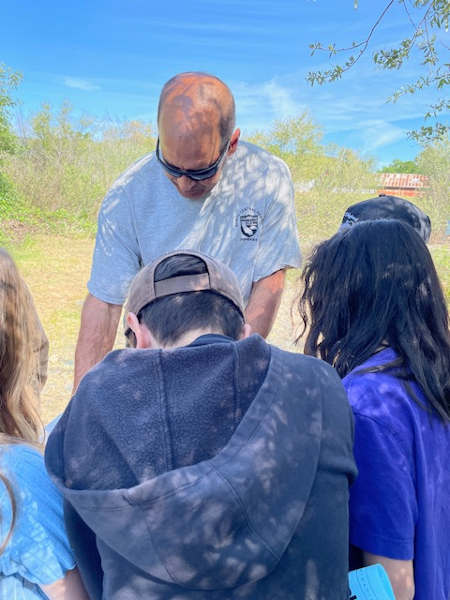
Harry Lyons, president of the Lake County Resource Conservation District and former ecology teacher at the Clearlake campus of Yuba (now Woodland) Community College, taught fourth graders about the many native trees here in Lake County, California. Photo courtesy of Lake County Resource Conservation District.

SOUTH LAKE COUNTY, Calif. — The Lake County Resource Conservation District, or LCRCD, held its annual “Field Day on the Creek,” on Earth Day, April 22, giving scores of young Middletown and Cobb area students the opportunity to enjoy hands-on nature experiences.

Students learned about local birds and their feeding behaviors, native trees to Lake County, fish that live in Putah Creek, and the unique geology of this area.

A highlight of the day was the discovery of a Lamprey, caught in Putah Creek by California Department of Fish and Wildlife Biologist, Ben Ewing. He demonstrated how CDFW sends a mild current of electricity into the water in order to bring the fish to the surface. Other fish observed included suckers, minnows and sculpens.

CDFW biologist Ben Ewing identifies interesting stream fish for students. Photo courtesy of Lake County Resource Conservation District.


Students had a good time testing the fire hose, courtesy of U.S. Forest Service personnel and also learned about the quagga mussel and why it is a concern from the Water Resources Department – County of Lake.

The Resource Conservation District has held a Day on the Creek for almost 20 years. Students attend from Coyote Valley, Minnie Cannon, and Cobb elementary schools along with teachers and parent volunteers.

Also participating in this year’s event were the Redbud Audubon Society, geologist Dean Enderlin, Forest Service Hydrologist Hilda Kwan, the Tribal EcoRestoration Alliance, or TERA, and LCRCD board members, who encouraged citizen science.

Student Jack Montage learning about how bird's beaks impact what foods they eat. Photo courtesy of Lake County Resource Conservation District.

The Lake County Resource Conservation District is a non-regulatory special district of the State of California formed to promote conservation and sustainable use of natural resources.

It is a descendent of the Soil Conservation Districts that were founded in 1937 in response to the Dust Bowl crisis.

Your local RCD is involved with promoting locally-led programs aimed at conservation of natural resources and agriculture and also provides technical assistance to local landowners to support their conservation efforts through a variety of grant programs.

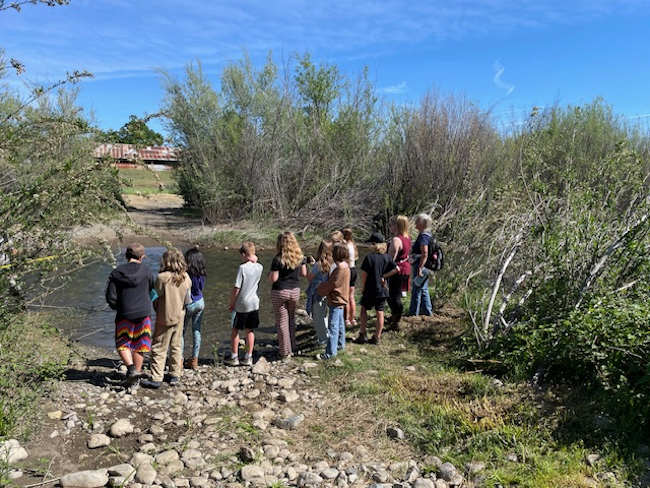
Students on Putah Creek. A 20-year project of the Lake County Resource Conservation District. Photo courtesy of Lake County Resource Conservation District.

Donna Mackiewicz, president of the Redbud Audubon Society taught students about how a bird's beak governs the types of food it will eat at her “Bird Beak Cafe.” Photo courtesy of Lake County Resource Conservation District.
Details
Written by: ROBERTA LYONS
Published: 27 April 2024
  1. Clear Lake boating restrictions lifted due to decreased lake levels
  2. Nearsightedness is at epidemic levels – and the problem begins in childhood
  3. Space News: Hubble celebrates 34th anniversary with a look at the Little Dumbbell Nebula

Subcategories

Community

  • 693
  • 694
  • 695
  • 696
  • 697
  • 698
  • 699
  • 700
  • 701
  • 702
How to resolve AdBlock issue?
Refresh this page
Copyright © 2026 Lake County News,California. All Rights Reserved.